Brazilian Jiu-Jitsu teaches students how to manage difficult positions, control movement, and escape from an opponent’s hold using technique rather than relying entirely on strength. For beginners, learning Essential Jiu-Jitsu escapes is one of the most important steps toward developing confidence on the mats. Instead of panicking when an opponent gains a dominant position, students learn to stay composed, protect themselves, create space, and work toward a better position.
At Five Rings Jiu Jitsu in Portland, Oregon, students develop grappling fundamentals through structured instruction that emphasizes leverage, timing, positional control, and practical self-defense. Whether you are completely new to martial arts or transitioning from another combat sport, understanding basic escapes can help you build a stronger foundation for continued training.
Why Essential Jiu-Jitsu Escapes Matter for Beginners
In Brazilian Jiu-Jitsu, an escape is a technique used to move out of an unfavorable position and regain a more manageable one. You might be pinned beneath an opponent, controlled from the side, or held from behind. Each situation presents different challenges, and the correct response depends on positioning, grips, timing, and your training partner’s movements.
Beginners sometimes assume that escaping requires explosive strength. However, Brazilian Jiu-Jitsu focuses on using body mechanics and leverage to make movements more efficient. A well-timed hip movement, properly placed frame, or change in angle can create an opportunity that brute force alone may not provide.
Learning escapes also teaches students to recognize danger before a position becomes more difficult to manage. Rather than making random movements, you begin identifying where pressure is coming from, which areas need protection, and how to create room for movement.
1. The Bridge and Shrimp Escape
The bridge and shrimp are two foundational movements that beginners use in many Brazilian Jiu-Jitsu escapes. They help students understand how to move their hips, create space, and change their body position while working from the ground.
The bridge involves lifting the hips to change the angle of your body and disrupt an opponent’s balance. The shrimp, sometimes called hip escaping, involves moving the hips away while using the legs and body positioning to create space.
These movements are particularly useful when learning to escape from mount or recover a guard position. They are also important building blocks for more advanced techniques.
Beginners should practice these movements slowly before combining them into complete escapes. Focus on coordinated movement, proper balance, and understanding why each action creates space. An instructor can help correct common mistakes, such as pushing without moving the hips or attempting to bridge while leaving the body poorly positioned.
With regular drilling, these movements become more familiar and easier to apply during controlled training.
2. How to Escape the Mount Position
The mount is a dominant ground position in which an opponent sits over your torso while maintaining control. For beginners, being mounted can feel restrictive because the opponent can use body weight and positioning to limit movement.
One commonly taught escape uses a bridge combined with controlling the opponent’s arm and leg. The general objective is to disrupt balance, create an opening, and move into a safer position. Another approach involves using hip movement to create space and work toward recovering guard.
The key is understanding that a successful mount escape depends on timing and coordination. Repeatedly pushing directly against an opponent who is balanced and controlling your upper body often wastes energy.
During practice, learn how to protect your head and arms, establish appropriate frames, and coordinate your hips with your upper body. Your instructor can demonstrate which escape is suitable for different mount variations and explain how to respond when the opponent adjusts their weight.
Avoid trying to force the movement through strength alone. Controlled repetition helps develop the timing needed to recognize opportunities.
3. Escaping Side Control With Frames and Hip Movement
Side control is another common position in Brazilian Jiu-Jitsu. An opponent controls you from beside your torso, often using chest pressure and body positioning to restrict your movement.
The first priority is to understand how to create protective frames. A frame is a structural barrier formed with your arms or legs that helps manage pressure and maintain space. Proper framing can make it easier to move your hips without relying entirely on arm strength.
Once you establish an appropriate frame, hip escaping can help create room to recover guard or move toward another defensive position. The exact sequence depends on how the opponent distributes their weight and controls your shoulders and hips.
Beginners should avoid extending their arms carelessly or turning away without understanding the risks. Poor positioning can expose the back or allow the opponent to tighten control.
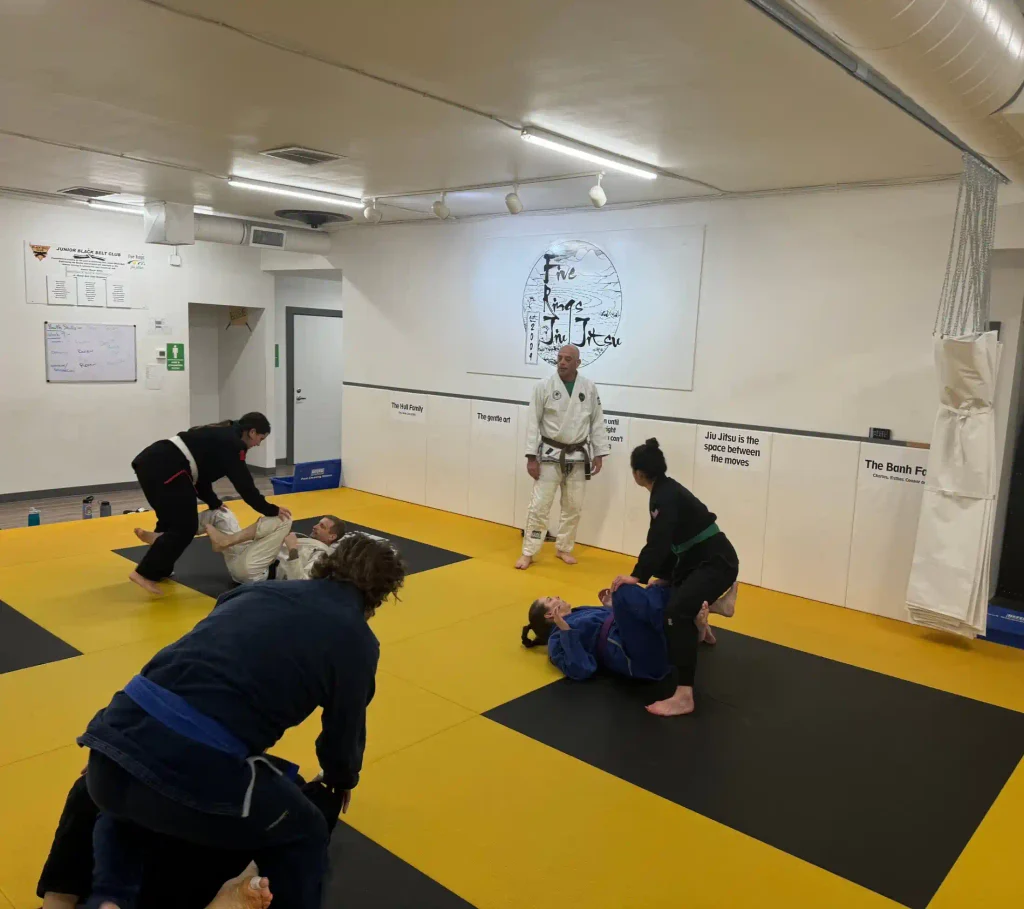
At Five Rings Jiu Jitsu, students can work on positional control and escapes as part of a structured Brazilian Jiu-Jitsu curriculum. Instructor feedback helps students understand how to position their bodies, conserve energy, and respond to changing pressure.
4. Understanding the Back Control Escape
Back control is a powerful position because an opponent can control your upper body while positioning themselves behind you. In Brazilian Jiu-Jitsu, defending this position requires awareness, careful movement, and attention to the opponent’s grips.
Beginners should learn to protect their neck, understand the importance of hand fighting, and recognize how an opponent maintains control. Turning or moving without considering the opponent’s position can make an escape more difficult.
A typical back escape involves addressing the controlling grips, moving toward a safer angle, and working to bring the shoulders or hips back toward the mat. The correct movement varies depending on whether the opponent has established hooks, body control, or a particular grip configuration.
Because back control can involve submission threats, it is especially important to learn these escapes under qualified supervision. Practice slowly with a cooperative partner before introducing more resistance.
Students should also understand when to pause, communicate discomfort, or tap if a submission is applied. Safety and control are more important than completing a technique at any cost.
5. Recovering Guard When an Opponent Passes
Guard recovery is the process of returning your legs between yourself and an opponent when they have moved around your defensive position. It is an important skill because the legs can help manage distance, establish frames, and create opportunities to control movement.
For example, after an opponent passes your guard, you may need to turn your hips, create space, and bring one or both knees back into position. The movement must account for the opponent’s pressure and the space available.
Beginners should focus on maintaining awareness of their hips and shoulders rather than moving only their upper body. Keeping the body aligned and using controlled hip movement can make guard recovery more efficient.
Guard recovery also connects many other escape techniques. The same principles of framing, creating angles, and moving the hips appear in mount escapes and side control defenses.
Consistent drilling helps students recognize opportunities to recover guard before the opponent fully stabilizes a dominant position.
Common Mistakes Beginners Should Avoid
Learning Essential Jiu-Jitsu escapes takes time, and mistakes are a normal part of the process. Understanding common errors can help beginners improve more efficiently.
Relying only on strength: Trying to push an opponent away with maximum effort can quickly cause fatigue. Learn to use frames, angles, and leverage instead.
Holding your breath: Tension and shallow breathing can make training feel harder. Practice staying calm and breathing steadily while working through controlled drills.
Moving without a plan: Randomly twisting or pushing may expose your back or create additional problems. Learn the purpose of each movement and follow the technique taught by your instructor.
Ignoring defensive priorities: When trapped in a dominant position, protecting yourself and managing pressure should come before attempting a complicated counterattack.
Training too aggressively: Escapes require repetition and feedback. Excessive force can make learning less effective and increase the risk of injury.
Expecting instant results: Timing and body awareness develop gradually. Consistent practice is more valuable than expecting every escape to work immediately.
How to Practice Escapes Safely and Effectively
A good training routine begins with understanding the position before attempting the escape. Ask your instructor to demonstrate the starting position, explain the main objective, and identify the most common mistakes.
Start with cooperative drilling. Your partner should provide enough resistance to make the movement meaningful without preventing you from learning the technique. As your understanding improves, gradually increase resistance under your instructor’s guidance.
It also helps to practice one escape at a time. Repeating a movement with attention to detail allows you to identify where your positioning breaks down. Once you understand the fundamentals, connect related techniques into a sequence.
For example, a beginner might practice framing from side control, creating space with a hip escape, and recovering guard. Another session might focus on mount defense and recognizing the correct moment to bridge or move the hips.
Learn Essential Jiu-Jitsu at Five Rings Jiu Jitsu in Portland
Developing reliable escapes starts with quality instruction, consistent practice, and a willingness to learn from mistakes. Five Rings Jiu Jitsu offers Brazilian Jiu-Jitsu classes in Portland for students working to develop fundamental grappling skills, positional control, submissions, sweeps, and escapes.
The academy emphasizes structured instruction, personalized feedback, and technique development for different experience levels. Students can explore both Gi and No-Gi training while building an understanding of leverage, timing, and ground control. These fundamentals are valuable for recreational practitioners, aspiring competitors, and people interested in practical self-defense.
If you are new to Brazilian Jiu-Jitsu, you do not need to master every escape before attending your first class. Start with the basics, ask questions, and allow yourself time to develop confidence. Learning how to respond calmly from difficult positions can make training more productive and help you build a foundation for more advanced techniques.
Contact Five Rings Jiu Jitsu at (503) 327-8265 or visit 8775 SW Canyon Lane, Portland, OR 97225, to learn more about its programs and beginner training opportunities. Take the first step toward improving your grappling skills with structured instruction and a supportive martial arts community.